Portions from a previously published blog piece
Dear Judy Blume,
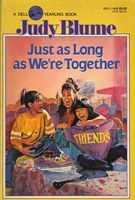
This is the one. This book, the yellow framed paperback, is one that always had a place in my bedroom. It went with me to a college dorm room and my first apartment. This is the copy I still have today. It sits with The House on Mango Street, Love is a Mixtape, and a copy of Emily Dickinson poems: comfort books I read whenever they’re needed.
It’s definitely not your most controversial book, but for a group of girls in elementary school, it was the first time we dealt with censorship, the first time we realized that sometimes teachers lie, and the first time we stood up for something.
One of the girls in our group had read it and quickly told us about how Stephanie, Rachel and Allison, the three best friends in the novel, had heard that hairy legs on a boy meant he was “experienced.” When the weather turned warmer in Michigan, we would look at boys’ legs and laugh.
Okay, we all needed to read this book. And then it was gone. It was a hard book to miss on the shelf–it was a bit longer than a lot of the books in our classroom library. We dug through the check out cards in the bin by the books. Nope. Nobody had checked it out. Finally, one of us had the nerve to ask the teacher.
“Do you have a copy of Just as Long as We’re Together?”
She looked to the side, as if she was giving the question a lot of thought. “I don’t think we have that book anymore,” she said slowly, followed by a flippant, “Sorry.”
We left her desk feeling dejected … and angry. It was a lie. Or at least a half truth.
So of course, we wanted to read it even more.
And we wanted to show her. As soon as the book showed up in the Scholastic Book Orders, we all ordered our own copies. When the books finally came and our teacher had to distribute them, we kept our books on our desks proudly. And we read. About Jeremy Dragon. About Stephanie getting her first period. About friendship. And we couldn’t put it down.
“Stephanie is into hunks” (1). From the first line of this book, my fourth grade friends and I were hooked. This wasn’t Tales of a Fourth Grade Nothing or even Blubber (great as those are). Stephanie had a poster of a young Richard Gere hanging over her bed, prompting her mother’s description and for fourth graders just starting to get copies of Tiger Beat for Fred Savage and NKOTB pictures, Stephanie was a character we wanted to and could relate to even more than Peter Hatcher. Stephanie was our heroine.
Stephanie is the perfect protagonist because she is so relatable. We even get some good old fashioned body shaming from her mom, a rite of passage for any Gen X girl. And even if someone doesn’t relate to Stephanie, we also get Rachel, Stephanie’s long time best friend who is a perfectionist, right down to her perfect notebooks, and Alison, the new girl at school who can speak with her dog and whose adopted mother is a famous actress. Stephanie as our narrator makes us see Rachel and Alison as our friends as well. Times when their friendship is strained, as most 7th grade friendships are at some point, we don’t get to see Rachel and Alison’s point of view, just Stephanie’s frustration in trying to work through issues, trying to figure out changes in her life and her friends as well. This endears us to Stephanie because it’s something so timeless.
I’ve always wondered though, what made our fourth grade teacher pull the book from the classroom library? What was so controversial? Why couldn’t she see what I still see today as a timeless beautiful story?
There are no “swear words” in the book. The girls in the book never have sex. Some sweet first kisses are as far as they go. When they discuss sex, it’s in that same innocent, strange rumor way that is normal and typical of a pre-teen (at least I hope that’s how pre-teens still discuss sex–who knows). Stephanie gets her period. While these topics were deemed taboo by our teacher, prompting her censorship, I am forever grateful for Stephanie, Rachel and Allison, just as much as Margaret and Katherine, for being our guides through growing up and for starting very important dialogues. isn’t this what literature should do–inspire dialogue, cultivate introspection and empathy, and inform?
My Scholastic Book Club sits next to me now as I write this, 30 some years after my first read. I have taken it out to read when I feel lonely, when I want to reminisce, when I just want to relax before bed. I have never put my copy in my classroom library for fear of it being damaged or a student not returning it. Now a mother to daughters, I will let them read it one day, even in fourth grade. But they will have their own copies. Still keeping mine.
Thank you, Judy
 Katherine Hamadeh
Leave a comment