Dear Judy Blume,
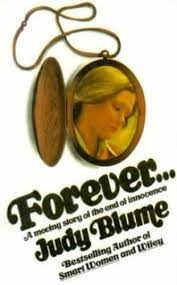
I just finished Forever… I never read this book and keep trying to think if it was in our school library. And then I keep thinking of Mrs. Kirk, our (maybe?) long suffering school librarian. Mrs. Kirk was a woman of few words, except apparently when she was on morning duty. In a scenario I cannot imagine being possible today, before school, everyone could play on the playground. It was a town where a lot of kids walked to school or rode their bikes, so if you got an early start that morning and were there by 8:30 am? You had a half hour of play time on the playground. If your parents drove you to school and maybe had an early meeting or punch in time at work? Drop the kid off. Let them play on the playground. And one person was seemingly in charge of keeping track of maybe 200 kids on a huge expanse of playground covered by a canopy of 100-year-old maple and oak trees: the school librarian Mrs. Kirk.
When the bell rang, everyone would file in the “recess doors” and someone told me he always heard Mrs. Kirk muttering curses at us as we walked inside. “Damn kids.” I don’t know how she got stuck with this duty. I don’t know if the kid-cussing story is true. But reading Forever … and trying frantically to remember if the book was in the school library, I kept imagining Mrs. Kirk reading about a penis named Ralph, shaking her head, thinking this should absolutely not be in the elementary school library, but reading every page intently … and smiling.
I also kept trying to imagine if my friends and I had read this book in the early ‘90s, on the cusp of the abstinence revolution, coming off the very conservative ‘80s, what we might have thought. Forever… and its story of teenage Katherine and Michael falling in love, experiencing sex and first love, was revolutionary for its time in its very sex-positive message. They fell in love, they had sex, nobody got pregnant, nobody died, and life continued, as it usually does. The conversations Katherine has with her parents and very liberal grandmother about sex, access to contraceptives, I think were a very idealized 1970s image of what the future would hold for sex education as opposed to what actually happened in the 1980s where everything was dangerous. Everything was sinful. We were supposed to just say no to drugs. If we had sex, we’d get pregnant. We’d get AIDS. We’d die.
So if someone in my elementary school friend group had picked up this book, in this environment, what would’ve happened? We all would have read every single line. My friend who had the bust-growth graph likely would have highlighted the racier parts of Forever and hidden her annotated copy under her mattress.
As the daughter of a Pentecostal minister, someone who attended church, on average, at least three times a week for most of her childhood, my own relationship with sexuality was complicated, to say the least. The only message was don’t. Pair that with conflicting messages about self-love and the ever-present anxiety about possibly missing The Rapture and/or going to hell, and the result is a lot of issues. I’ve tried to work out some of those issues in my own writing. The protagonist in my own (unpublished) young adult novel has a lot to sort out. But would that protagonist have looked different if I had read Forever when I was a teenager, especially with a protagonist that has the same name as me–and the same spelling! I don’t know if you know how huge that is for a Katherine–so many variations on that name. I’ve been spelling it out forever.
As a pre-teen/teenager, I think I would have been swept up in a romance story. Katherine and Michael fall in love fast. I think younger me would have idealized the relationship, and definitely passed around the sex passages with my friends.
As an adult reader, the seemingly idealized relationship was one of my criticisms of the novel. I wasn’t really sure what attracted Katherine to Michael. I didn’t get what made them click other than he’s cute, she’s pretty, but then again, maybe that’s the basis of a lot of teenage relationships. I just know as a reader, I wanted a more complex relationship. I also wanted to see more of Katherine as a character. The story is in 1st person and we see everything through Katherine’s eyes, but as a character, she doesn’t seem to have a lot of flaws. There’s no other side to her propelling her towards actions or decisions. She just seems to be a beautiful upper/upper-middle class girl without a lot of care in the world, and I just wanted more from a protagonist.
Those dirty parts I would’ve definitely passed around to my friends? I saw those differently as an adult too, and in those, I am so struck by your courage as a writer. I have read some criticisms of the book that describe the sex scenes as “cold” and “clinical” but I read them as real. Through this book an adolescent who isn’t going to get a talk about sex except for “don’t” can see a very straightforward portrayal of sex. Sometimes it is awkward. Sometimes it can be great. And a lot of times it can be kind of meh. And this book is very honest in that regard.
Also, through the conversations Katherine has with her mother and grandmother, as a reader, one can also experience those conversations. So if a young person was nervous about going to the gynecologist or Planned Parenthood, Katherine’s experience gives a preview of what might happen, ease the reader’s mind and help that young person to make responsible decisions about their body and sexuality as well.
I can see the book feeling a little dated for today’s generation with their access to all their questions about sex in the palm of their hand. Literally. But for a generation of teenagers who barely got a sex education class and seem to have a lot of common experiences of seeing a naked woman for the first time when finding a stack of abandoned Playboys in the woods (seriously, Google Woods Porn-total Gen X Phenomenon), Michael and Katherine’s story is so important.
The end of the book seems so optimistic. Published in 1975, when Katherine ends the book breaking up with Michael and not feeling guilty, not pregnant, not riddled with disease or shamed by her family, just looking towards the future, you, as a writer, probably imagined a very sex-positive future. And here we are almost 50 years later, and book bans have come back into vogue, reproductive rights are in peril, and we are once again choosing between two octogenarians for president, one of whom prides himself on getting rid of Roe v. Wade.
So thank you again, Judy Blume, for, through Katherine’s eyes, dreaming of a better society for all, for being brave again, for having much healthier conversations with a generation of kids than those Playboys in the woods. Sorry things are kind of messed up, but some of us will keep dreaming and writing and advocating for that future Katherine saw.
 Katherine Hamadeh
Leave a comment